Aux switches don’t have an up or down position, it always reverts back to the neutral middle position - it’s a momentary switch.
I don’t have my mmWave hooked up to an aux switch to test, but I would expect if you hit up on an aux when the light is on, nothing happens, and vice versa when you hit down when it’s off.
I do know when I’ve been on the treadmill (it can see me) and I’ve turned the light off in Home Assistant, it will stay off and not come back on until after it clears occupancy and then detects someone again.
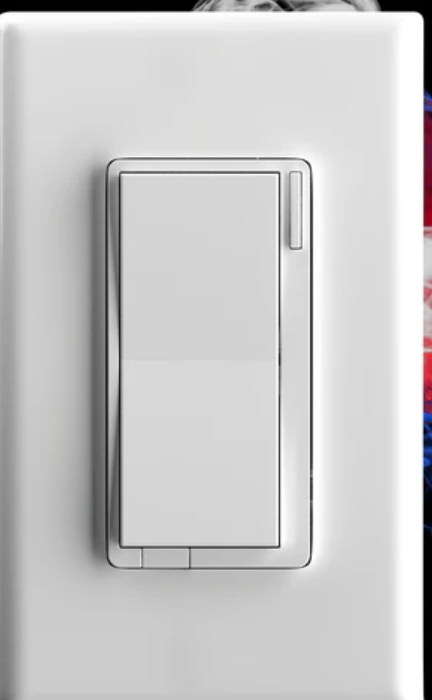
The picture of the Inovelli Switch locks like a standard switch, but up or down or Rock positions should not matter. If what you say is true, it makes no sense for the AUX married to the smart switch to work this way as it will no longer be a three way or 4 way circuit. The definition of these configuration is being able to control the light from any switch.
Aux switches and smart paddle switches are momentary switches. They all return to the neutral (center position) after you push up or down and it processes your input. This does not prevent the Aux switches from controlling the load from any number of different locations.
Since I don’t have any first-hand experience using Inovelli switches in multi-ways, I hope this isn’t a red-herring to the discussion here, but I gotta think this will factor in somehow…
How are you intending to set up P110 on your mmW switch?
I understand this parameter very well. This doesn’t help my understanding on how this multi smart switch works. I would like someone from Inovelli to address the logic of this switch. Is it a 4 way when used with 2 AUX switches or is it something else?
A 4-way circuit uses two 3-way switches at the ends and one or more 4-way switches in the middle to control a light from three or more locations,
For a DUMB multi-way switch leg, that is correct. However, a SMART multi-way is wired differently, but the operation of the switches is essentially the same.
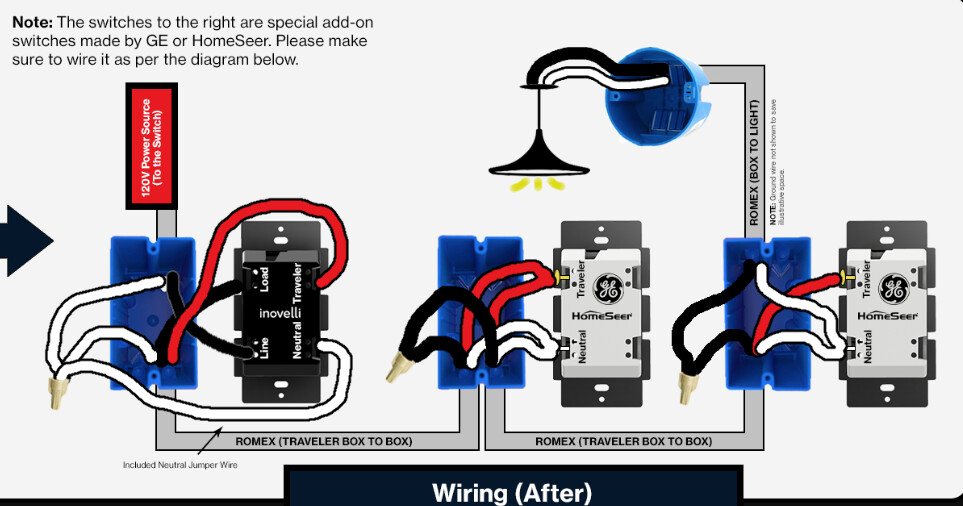
In a SMART multi-way, the Inovelli switch or dimmer is the load switch and may or may not be in the load box. The Aux switches are wired to the Inovelli via two conductors, one for signaling and one for power.
The load is powered on or off by the Inovelli switch exclusively. When you press up on the Inovelli, the light goes on and conversely, when you press down on the Inovelli, the light goes off (presuming the default paddle settings).
Unlike in a DUMB multi-way, the Aux switches work differently in that they do not carry the switched hot. The switched hot is sent by the Inovelli directly to the load. It may be passed through the other boxes but not connected to the Auxs. Instead, the Aux’s send a signal to the Inovelli to turn on or off.
So when you press up on and Aux, it will tell the Inovelli to turn the load on (if it’s off . . otherwise nothing). Conversely, when you press down on the Aux, it will tell the Inovelli to turn the load off (if it’s on, otherwise nothing.)
The only difference between the Aux and the DUMB switches is that up is always load on for the Aux and conversely down is always load off for the Aux. This differs from DUMB switches that depending on position, may be flipped into the opposite position to turn the load on or off.
I understand this, but I don’t understand what happens with detected? I plan on using the Inovelli smart switch to turn on the light when it detects. What happens when I hit the aux switch when the Inovelli is in detected mode? Does it clear the detected then turn off the light based on the time delay set or is it immediate? Right now one of my aux switch will be out of the detected zone. If I toggle this switch what happens to the Inovelli smart switch? Is there a way that someone from Inovelli @EricM_Inovelli (?) can add further details to how this switch works in a multiway configuration?
The Aux simply tells the Inovelli to either turn on or turn off. The aux switch does not interact with the detection it only interacts with whether the load is on or off.
So if the Inovelli turns the load on due to a detection and you press down on the Aux switch it will turn the load off, just like it would turn it off if the load had been turned on in any other fashion, such as pressing up on another switch or turning it on via the app.
Pyhsical and remote control override the presence detection. If you turn on the switch physically or with an aux, it won’t turn off until you physically turn it off. Once it is in the off position if presence is later detected it will turn on (if that is what is configured on the switch).
Great. That is what I was hoping for, to turn off when I press the Aux and to turn back on when a new presence was detected. Does HA see the switch as clear? @bry Eric’s response seems contrary to what you said. This is why I asked for someone from Inovelli to clarify. I was not looking for what people believes will happen, but what the switch is designed to do.
What he said is that it over rides the physical detection. What you said is “The Aux simply tells the Inovelli to either turn on or turn off. The aux switch does not interact with the detection it only interacts with whether the load is on or off” . To me this is not the same. I asked for clarification if it sets the switch to clear or not. I can set automations in HA based on what happens to the switch. I really did not want to rely on trial and error but work with what the switch is designed to do. This is why I posted the original post to try and get the design points. Not sure if you are aware, the online documentation was incorrect for the VZM-32-SN that Eric corrected a few days ago. The documentation error caused me to try the switch with 2 dummy switches and not understand why it was not working per the wiring diagram shown in the online docs. I don’t want to go through this again. I just want to make sure when I install the Aux switches I do it correctly to achieve a 4 -way circuit.
So what you’re asking, I think, is that if a switch detects motion and turns on the light, will turning off the light cause the switch to revert the motion status from “Motion detected” to “No motion”. I think that’s what you mean by “clear”.
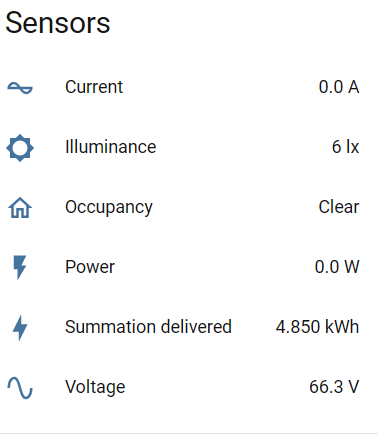
@EricM_Inovelli can clarify for you. But MY mmWave switches that display “Motion detected” continue to display “Motion detected” through the normal timeout. They do not revert to “No motion” early just because the load was turned off.
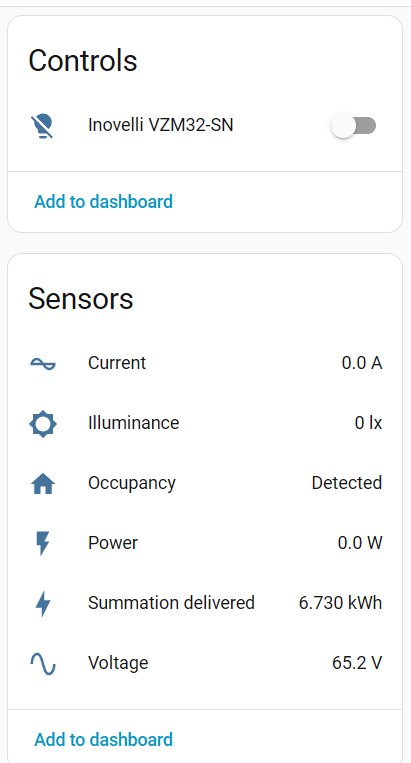
That is the question. When @EricM_Inovelli says override, I took this as Clear (detected and Clear is what I see in Home Assistant for the switch). He further stated that “Once it is in the off position if presence is later detected it will turn on”
If it leaves it detected than this would not be turn unless it times out and goes to clear by itself.
I would think these conditions should be documented, so none of us are guessing what the switch will do?
Maybe a logic diagram of the switch with conditions would be helpful to add to the documentation?
When I look at the wiring diagram, I only see the neutral and travelers attached to the AUX switches. I see the Load connected in the 2 boxes. I believe (can’t confirm yet as I don’t have the AUX switches) that the switch positions tell the smart switch to power on or off the load wire.
The load and the presence are two separate entities. You can control the load without it changing the presence. If you turn the switch off manually presence will remain as “active” as long as the sensor detects presence. When it does not detect presence anymore then it will become “clear”. Then, if presence is detected again it will control the load based on what the configuration is set to.
I believe I now understand. Thank you. Clear and detected are only changed by the mmwave device. Nothing to do with the switch or the Aux switches. A change in the AUX sends a signal to the smart switch to turn the load line on or off depending on it’s current condition. The smart device does not change its detected or clear condition.
If need be, I can use an automation in HA for the switch condition and occupancy and change any conditions from there.
Just wired in the 2 Aux switches and the do turn the light on and off correctly. The smart switch changes colors from Blue to White when either Aux Switch is press while there is a presence detection. Is this correct?
HA sees