VTM30-SN to turn on/off HVAC Blowers and Gas Furnace - any issues?

For several years, I have been using Jasco 43078 Zigbee switches to control my two HVAC blowers and furnaces in the attic without any issues. These two switches are always on and are there simply to power down the blowers in case of a fire so smoke is not spread throughout the house more quickly.

It is important to note that I live in Texas, so the attic can easily reach 40°C or more during the summer. However, I am unaware of any issues with these relay-based switches operating in those conditions.

The furnace is gas-powered, so its power draw is negligible. The blower draw is between 600W and 800W. The blower itself is just a basic AC fan motor.

I am trying to build out my Thread mesh network, and given the many Zigbee-related issues with Jasco products, along with the lack of updates, I am on a quest to remove them all. All of my smart outlets and attic switches were Jasco devices. I purchased a 5-pack of VTM30-SN switches and have already replaced the three light switches in the separate attic spaces. Those are low-power LED loads, configured as relays, and are normally left off anyway. To date, I have not had any issues (max temp reported by switch since install 39C).

I would like to use the remaining two VTM30-SN switches as emergency shut-off switches for the HVAC blowers and furnaces. However, I have found conflicting information on these forums regarding these types of loads, especially larger AC fan motors (assuming all relay based switches share the same limitations). I am hoping to get a better understanding of the feasibility and potential risks.

Would using the VTM30-SN to switch HVAC blowers and gas furnaces on and off be an issue?
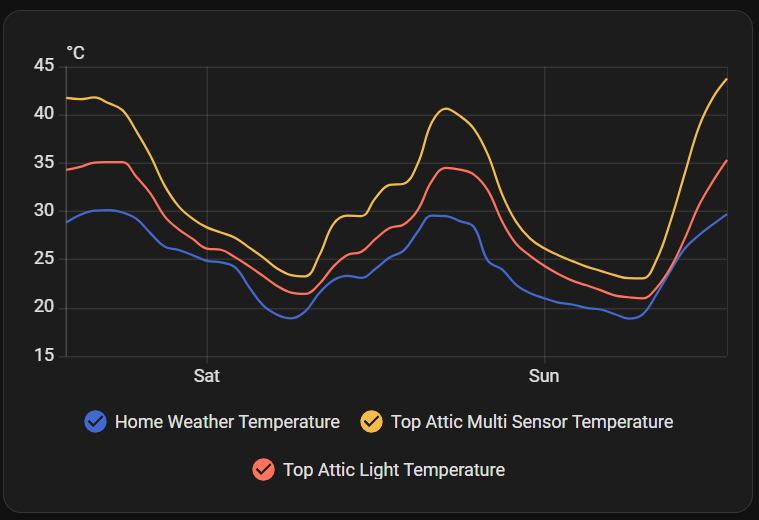
I’m afraid that temp exceeds the published operating limit for the VTM30-SN (which is 35°C).

The specs are towards the bottom of the VTM30 manual page.

The same limit is in the “Tech Specs” page of the Inovelli store.

Note that the temperature reported by the device is “internal temperature”. The VTM30 is not sold as having a “room temperature monitoring” feature.

@andrewk I am aware, but that is a good point worth discussing further.

These are my thoughts:

Sometimes companies, especially smaller ones, choose a temperature range based on where they expect most customers to use the product and test against that target usage scenario. A 35°C limit covers most indoor environments, excluding garages and attics in hotter climates. I am not ready to disqualify this product for garage and attic use, as I suspect it will work just fine.

It is also likely that the published temperature specification is selected to guarantee a certain product lifespan. I am comfortable trading some longevity for the ability to use it in non-conditioned spaces. I have had smart switches in my attics and garage for many years without failures, including the infamous Jasco outlets and switches with the electrolytic capacitor issue that causes the “click of death” (I have repaired quite a few of these, mostly outlets, in my own home). As long as the expected failure mode is not a “thermal event” (R&D lingo for fire), premature failure is not a major concern, assuming it still lasts at least two or three years like the others I have used in those environments.

As for my example, since the operating temperature specification refers to the ambient environment and the value I reported is the switch’s internal temperature, I may still be operating within spec. I have some Inovelli 2-in-1 dimmers installed indoors that I have seen report internal temperatures around 50°C without triggering the “overheated” flag, assuming the flag remains latched once tripped. It would be interesting to know the actual temperature threshold at which protection activates.

Aside from operating temperature, what about the load type?

The load consists of low power control circuits for the furnace and blower, along with the blower itself, which represents the higher load at approximately 600 to 800W (an inductive load). I am guessing that inrush current could be the concern here, as it can be significantly higher than the running current. However, the relay in the switch will always remain on. It would only turn off in the event of an emergency to prevent the blower from operating during a fire.

EDIT:

This surprised me:

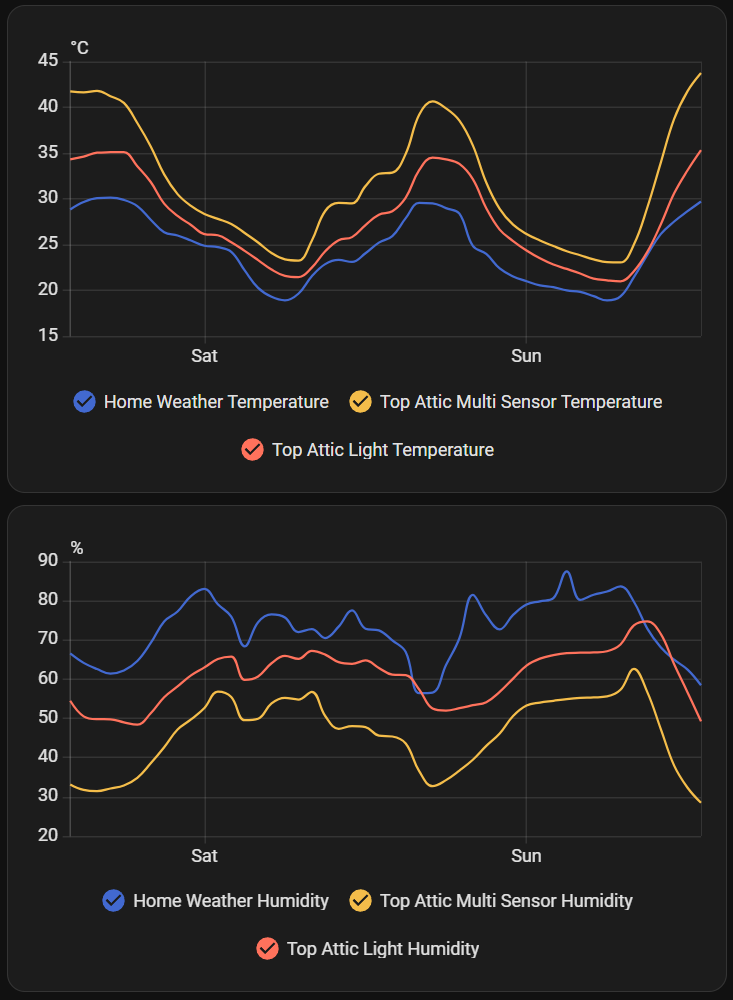
Yellow - actual top attic temp (verified across range before installing in attic)

Red - VTM30-SN internal temp (light off)

Blue - OpenWeather Forecast Temp which most often is <1C compared to my outdoor sensors

It’s cooler inside the switch than in the hot attic it is located??

On an unrelated side note - I am guessing Inovelli needed a temp sensor to detect overheating situations, but opted for a temp + humidity sensor as nearly free bonus feature they can market on (ex.: bathroom exhaust fan use case).

I have used many of these sensors on my esphome projects and found that the esp32 itself can skew the temperature measurement which in turn skews the relative humidity reading as it is calculated based off of the temperature. This makes me question the accuracy of the humidity readings when the internal temperature is significantly different than the environment (likely always).

I’ll have to test this… :slight_smile:

EDIT:

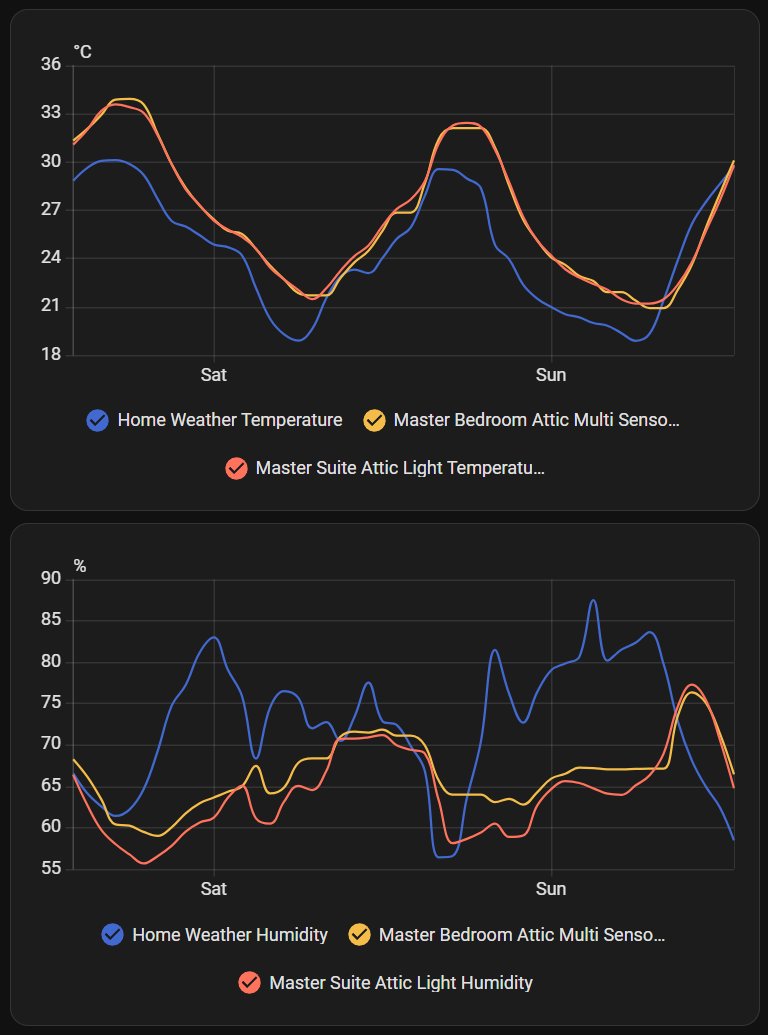
I forgot I already had the data to compare…

Absolute water content in the attic air is likely similar to the outdoor air, but the relative humidity percentage differs because it is temperature dependent. As the attic air warms up, the same amount of moisture represents a smaller percentage of the air’s moisture holding capacity, resulting in a lower rH%. However, the light switch and the multi sensor are in the same space… but differ by 20%rH… need to look into this further.

EDITn+1:

This attic is always cooler… and the switch and sensor are side by side. These match quite well.